
.jpg)
Because when the second bottle opens and nobody planned for it, the person who thought ahead always wins the next morning.
Here's why casual nights hit harder than you think — and how to actually show up ready.

There's a particular dynamic at play during relaxed social events that makes alcohol consumption — and its after-effects — surprisingly significant.
The pacing is different. At a bar or a club, drinks are usually ordered in rounds with natural gaps in between. At a housewarming or dinner party, someone is almost always refilling your glass. The bottle is right there on the table. You're mid-conversation, you're comfortable, and another pour just happens. Without the structure of ordering and waiting, it's genuinely easy to drink more than intended — not because you're trying to, but because the environment encourages it.
You're not moving. Sitting down for hours while drinking is physiologically different from standing, dancing, or walking between venues. When you're stationary, alcohol moves through your system differently, and you may feel the effects more acutely — and feel them longer.
The food situation is unpredictable. Sometimes there's a full spread. Sometimes there's a charcuterie board that runs out by 8pm. The presence or absence of a proper meal dramatically affects how alcohol is absorbed. Without food slowing that process down, your blood alcohol level rises faster and stays elevated longer.
It's emotionally comfortable. This one gets overlooked. When you're relaxed, around people you trust, in a low-pressure environment — your body is less vigilant. You're not monitoring yourself the way you might at a work function. That comfort is a good thing for connection, but it means the usual mental checks on drinking often soften too.
Add all of this together, and what feels like "a casual night with wine and friends" can produce a next morning that rivals the aftermath of a much bigger occasion.
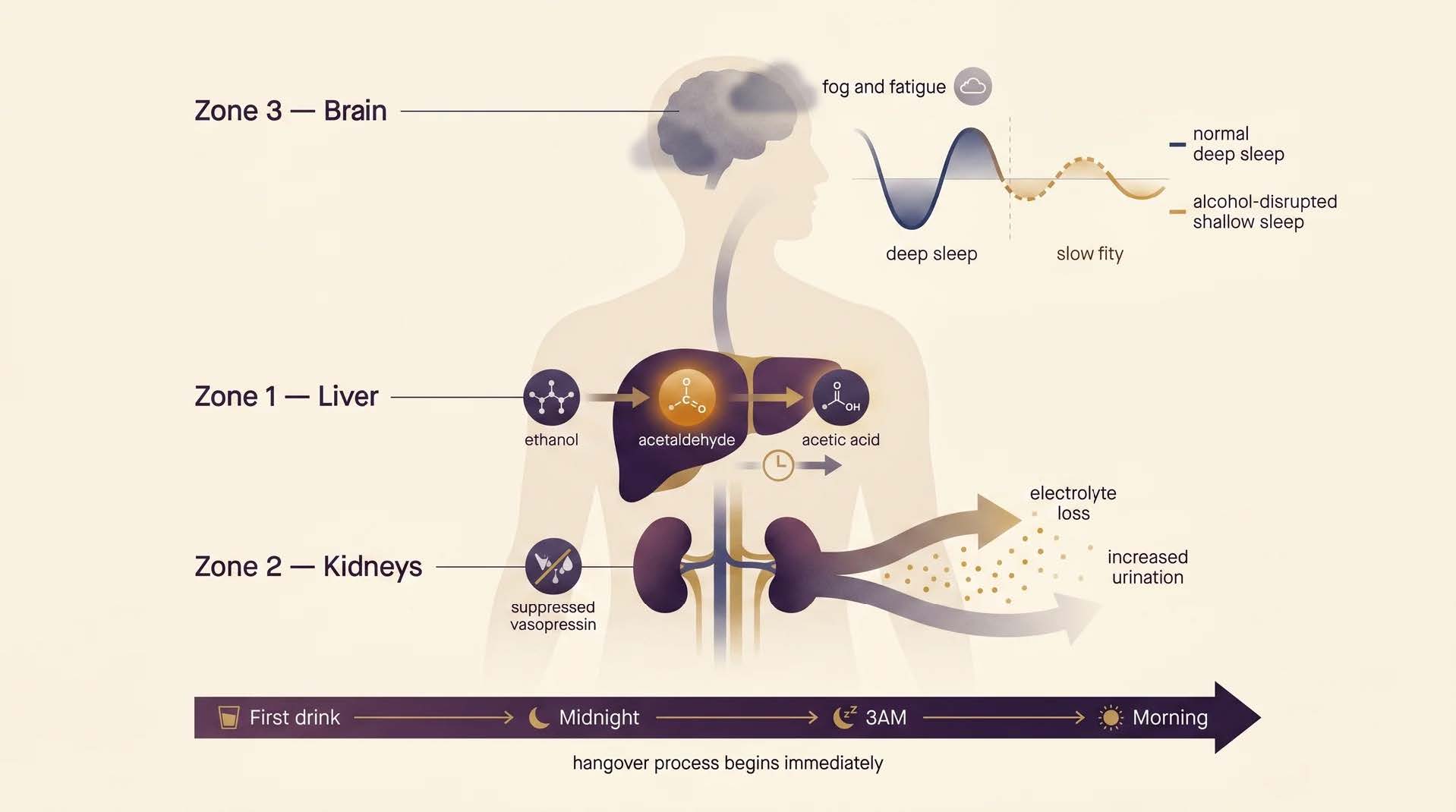
Understanding why you feel the way you do the morning after helps make the case for preparation.
When you drink, your liver begins breaking down ethanol almost immediately. The first byproduct of that process is acetaldehyde — a compound that's significantly more toxic than alcohol itself. Your liver then converts acetaldehyde into acetic acid, which is relatively harmless, but that second conversion takes time. When you drink faster than your liver can clear it, acetaldehyde accumulates — and that accumulation is the primary driver of hangover symptoms: the headache, the nausea, the fatigue, the brain fog.
Simultaneously, alcohol suppresses vasopressin, a hormone that tells your kidneys to retain water. Without it, you urinate more, you lose electrolytes, and progressive dehydration sets in — contributing to that dry-mouth, pounding-head feeling the next morning.
Alcohol also disrupts sleep architecture. Even if you get eight hours, alcohol reduces the amount of time spent in deep, restorative REM sleep. You wake up feeling like you barely slept — because physiologically, in the ways that matter, you kind of didn't.
And here's the part people often miss: all of this starts with the first drink. The hangover isn't a morning problem. It's a previous-night problem. By the time you wake up feeling rough, your body has already been managing the metabolic fallout for hours.
Preparation sounds like something you do before a big event — a festival, a wedding, a New Year's Eve party. But the biology doesn't care about the occasion. A casual housewarming involves the same metabolic processes as any other night of drinking.
The difference is that people rarely think to prepare for low-key events. They bring the wine, they show up, they enjoy the night — and then they're surprised by how they feel the next day.
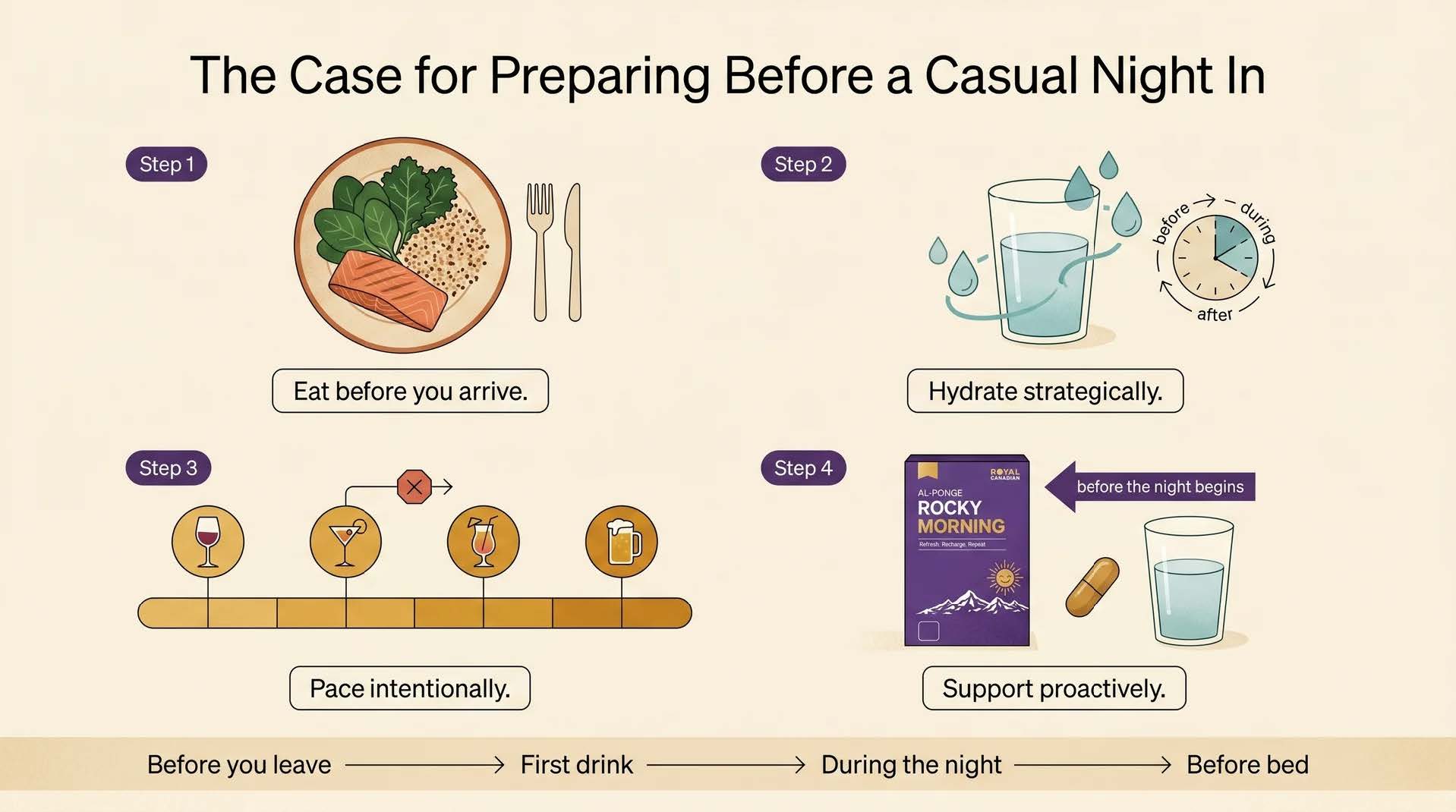
A smarter approach looks like this:
Eat before you arrive. A balanced meal with protein, healthy fats, and complex carbohydrates before you start drinking slows alcohol absorption and helps stabilize blood sugar throughout the evening. Don't rely on the charcuterie board.
Hydrate strategically. A glass or two of water before you leave, periodic water throughout the night, and a proper rehydration before bed. It sounds simple because it is — and it makes a real difference.
Pace intentionally. The liver processes roughly one standard drink per hour. At a casual gathering where the glass rarely empties, it's easy to far outpace that. Being aware of it helps — even if you don't count every drink.
Support your liver proactively. This is where supplementation makes sense — and where the timing matters. The earlier you take it, the more effectively it can do its job.
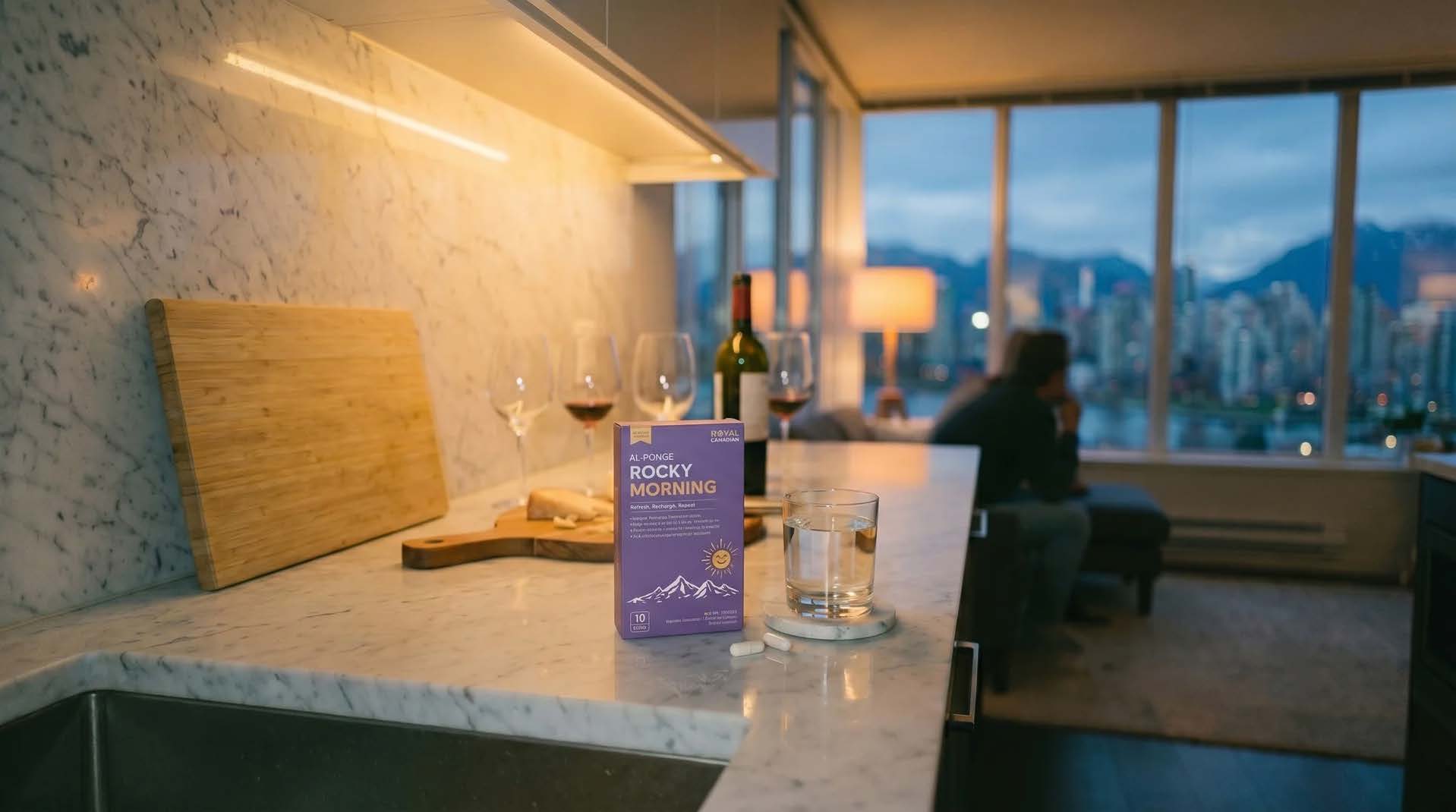
Rocky Morning was designed for exactly this kind of occasion — not just the obvious ones.
It's easy to think about hangover prevention for big nights. Festivals, bachelorette weekends, birthday celebrations — those feel like the "obvious" use cases. But the casual housewarming, the dinner that turned into drinks, the weeknight hang that stretched longer than planned — these are actually more common, and they catch people more off guard.
Rocky Morning's formulation is built around proactive liver support:
High-dose milk thistle (85mg, 80% silymarin) — Silymarin is one of the most well-researched natural compounds for liver health. It acts as an antioxidant, supports the liver's natural detoxification processes, and helps protect liver cells from oxidative stress caused by acetaldehyde accumulation. Taking it before you start drinking gives your liver better tools to handle what's coming.
Health Canada NPN certified — Rocky Morning is licensed by Health Canada as a natural health product, manufactured in GMP-certified facilities in North America. In a supplement category where quality varies widely, that regulatory accountability matters.
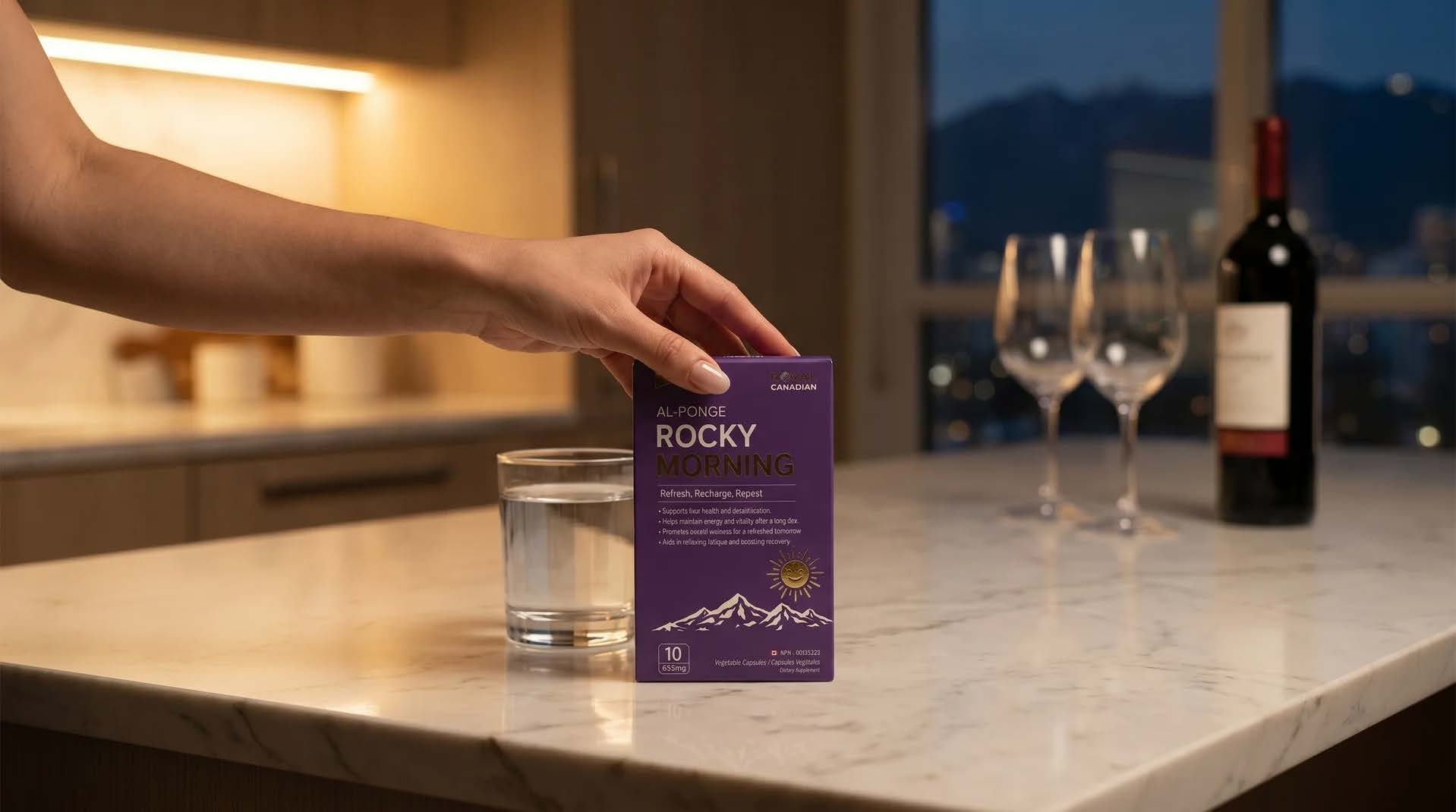
Slim, pocket-sized design — The 10-capsule blister pack is compact enough to fit in a jacket pocket or a bag. You're not carrying a supplement tub to a housewarming. The format is designed for real life — for exactly the kind of occasion where you might think to grab it on the way out the door.
The routine is straightforward: one to two capsules before the night begins, and one additional capsule before bed for longer celebrations. That's it.

There's a version of the housewarming story where the next day is simply the next day.
You sleep reasonably well. You wake up without the weight of a hangover pressing down on the morning. You maybe meet the same friends for brunch, or you get your workout in, or you just have a quiet productive Sunday. The evening was fun — and it stayed fun, including the morning after.
That's not an unrealistic expectation. It's just one that requires a small amount of preparation before the bottles are opened.
Because the best nights don't have to cost you the next day.
* This is for informational purposes only. For medical advice or diagnosis, consult a professional.

-01.svg)

%402x%20(8).svg)
%402x%20(8).svg)